Headless, Bold Nollywood Thriller That Couldn’t Hold Its Nerve
- Mar 29
- 4 min read
A Strong Premise Carried by Even Stronger Ambition
At its core, Headless is an ambitious and intriguing attempt to merge crime, psychological tension, and industry introspection into a single, layered narrative. The film centers on a Nollywood producer caught in a deeply unsettling situation, one that immediately pulls the audience into a web of suspicion, morality, and consequence. From the onset, it is clear that this is not just a conventional thriller, it is a film that wants to say something about power, influence, and the uneasy intersections between storytelling and real-life systems. There is a deliberate effort to balance entertainment with commentary, and for the most part, that ambition is commendable.
However, while the film shows flashes of brilliance in both concept and execution, it also struggles to fully sustain the weight of its own ideas, resulting in a viewing experience that is as promising as it is uneven. It is a film you admire for trying, even when it doesn’t completely land.
When Nollywood Turns the Camera on Itself
One of the film’s most compelling strengths lies in its meta-narrative, the way it turns the camera inward on Nollywood itself. Through its characters and unfolding events, Headless subtly critiques the ecosystem it exists within, examining how the film industry can sometimes mirror the very corruption and moral ambiguity it portrays on screen. This self-awareness gives the story an added layer of depth, making it more than just a suspense-driven plot. In many ways, it echoes the thematic boldness of films like Nightcrawler and Zodiac, where the narrative is not just about the central mystery but about the systems that enable it.
Headless thrives in these moments of reflection, where it pauses to interrogate the structures of power and the blurred lines between fiction and reality. It is in this space that the film feels most confident, most intentional, and most distinct from the average Nollywood thriller.
A First Half That Grips, A Second Half That Slips
That said, the film’s greatest strength is also where its biggest weakness becomes most apparent, its pacing and narrative consistency. The first half of Headless is, without question, its most gripping segment. There is a steady, almost suffocating tension that builds as the story unfolds, drawing the audience into its mystery with precision and control. The interrogation scenes are particularly effective, layered with psychological nuance and a sense of unpredictability that keeps you engaged. However, as the film transitions into its second half, that carefully built tension begins to slip. The urgency that once drove the narrative starts to fade, and the story becomes less taut, less compelling, and at times, less focused.
It’s not that the film completely derails, it simply loses the sharp edge that made its opening so captivating. This drop in intensity creates a noticeable imbalance, leaving you wishing the latter half had matched the discipline and intrigue of the first.
Visual Strength and a Daring Nollywood Moment
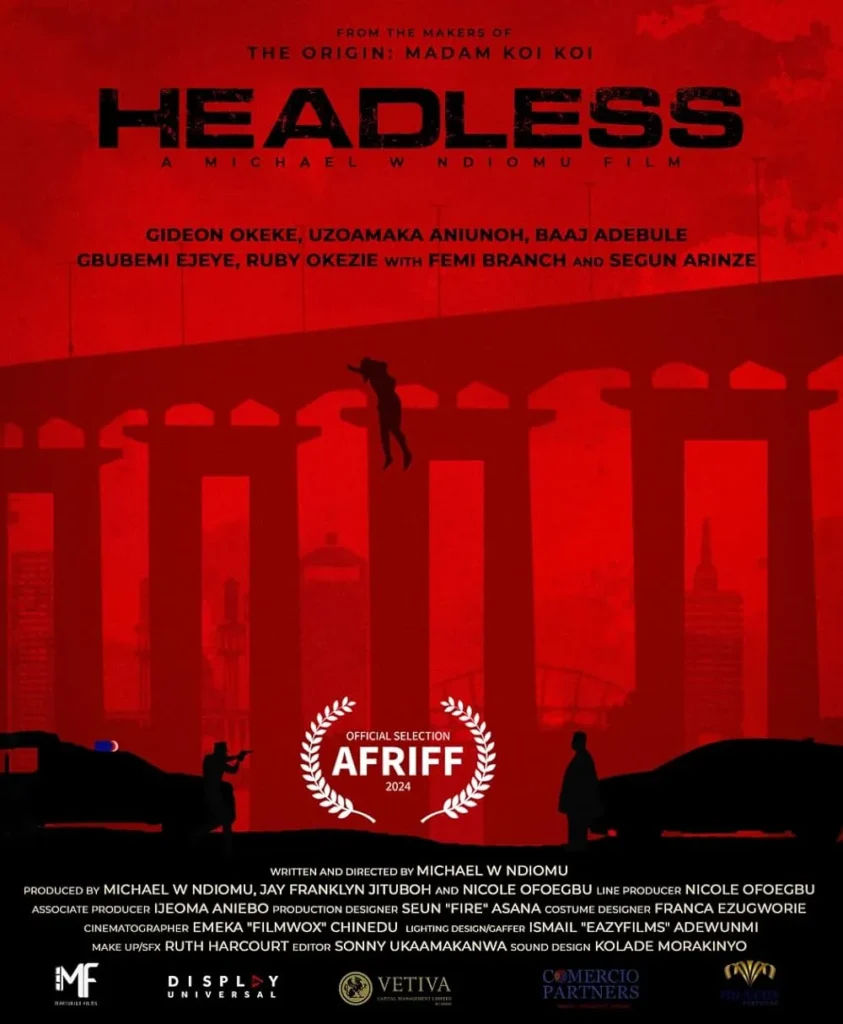
Visually, however, Headless holds its ground impressively. The picture quality is good, with a clear effort put into cinematography, framing, and overall visual storytelling. There is a level of polish here that signals growth within Nollywood’s technical space, showing that filmmakers are paying closer attention to how their stories are presented on screen. More notably, the film delivers a standout moment through Gideon Okeke’s performance, particularly the daring scene where he jumps off Third Mainland Bridge. This is not just a shocking visual beat; it is a significant moment for Nollywood as an industry. It is rare to see actors commit to such physically demanding stunts, especially without the use of a stunt double.
The execution of this scene adds a layer of authenticity and intensity that elevates the film, and it deserves to be recognized as one of its most memorable achievements. It is moments like this that push the boundaries of what Nollywood can do.
Performances That Hold The Film Together
Performance-wise, Gideon Okeke serves as the film’s emotional and narrative anchor, delivering a performance that is both controlled and compelling. He embodies the complexity of his character with a quiet intensity, allowing the audience to sit with his ambiguity rather than forcing clear answers. His presence carries much of the film, especially in moments where the script begins to lose some of its momentum. Supporting casts like Uzoamaka Power adds depth, but the film ultimately leans heavily on its lead to maintain engagement. In comparison to international thrillers like Prisoners, where character depth and emotional stakes remain consistently high throughout, Headless doesn’t always push its characters far enough in the latter half to sustain the same level of investment.
This creates a slight disconnect, where the performances remain strong, but the narrative doesn’t always give them enough to fully explore.
A Step Forward, Even If Not A Perfect One
Ultimately, Headless is less about perfection and more about progression. It represents a bold step forward in Nollywood’s ongoing evolution, particularly in its willingness to experiment with form, tone, and subject matter. The film dares to be introspective, to challenge its own industry, and to operate within a more complex narrative space than many of its contemporaries. Yet, it also highlights the areas where Nollywood still has room to grow, particularly in maintaining narrative tension and delivering fully cohesive storytelling from start to finish.
Headless may not completely fulfill its potential, but it undeniably signals a shift, a movement towards more daring and thoughtful filmmaking. And in that sense, it is a film worth engaging with, discussing, and even critiquing, because it opens the door for something even better next time.


Comments